

[SETTING] Feats of Might and Magic
Designing earned proficiencies in Ädamίr


This article is brought to you by the following paid subscribers who make this newsletter possible:
Azzlegog
Michael Phillips
Mori
Space Pirate
A Note of Warning: Some Spoilers for Ädamίr Ahead.
In Ädamίr, a character has proficiencies, representing languages, skills, and other learned mundane abilities.
Each character starts with a number of known proficiencies based on their Intellectualism (one of three attributes a character has, alongside Athleticism and Spiritualism).
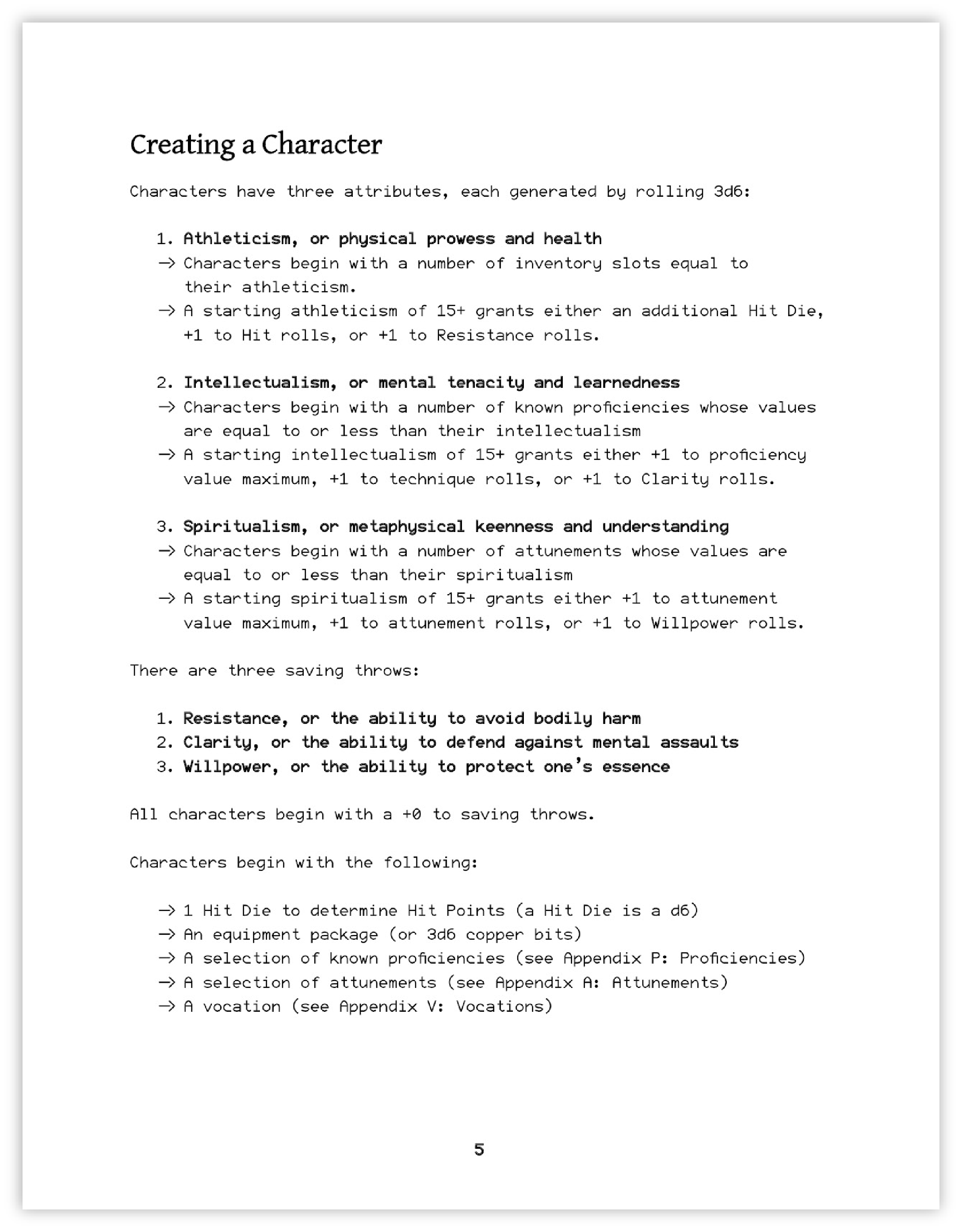
However, certain proficiencies can only be earned in the world; they aren’t available when selecting starting proficiencies.
The two most common ways of earning proficiencies past starting level are:
Covenant advancement through earned Reputation
Exploration and discovery through finding fantastic locations and extraordinary people
Once your character is built and out in the world, they are shaped by the people and places they encounter and what they can accomplish in relation to the two.
Covenant Advancement
Advancement through Covenants in Ädamίr follows a hub-and-spoke system, in which you start as a Recruit or with a similarly standard title and have the opportunity to progress outward in different directions by accomplishing various Covenant goals.
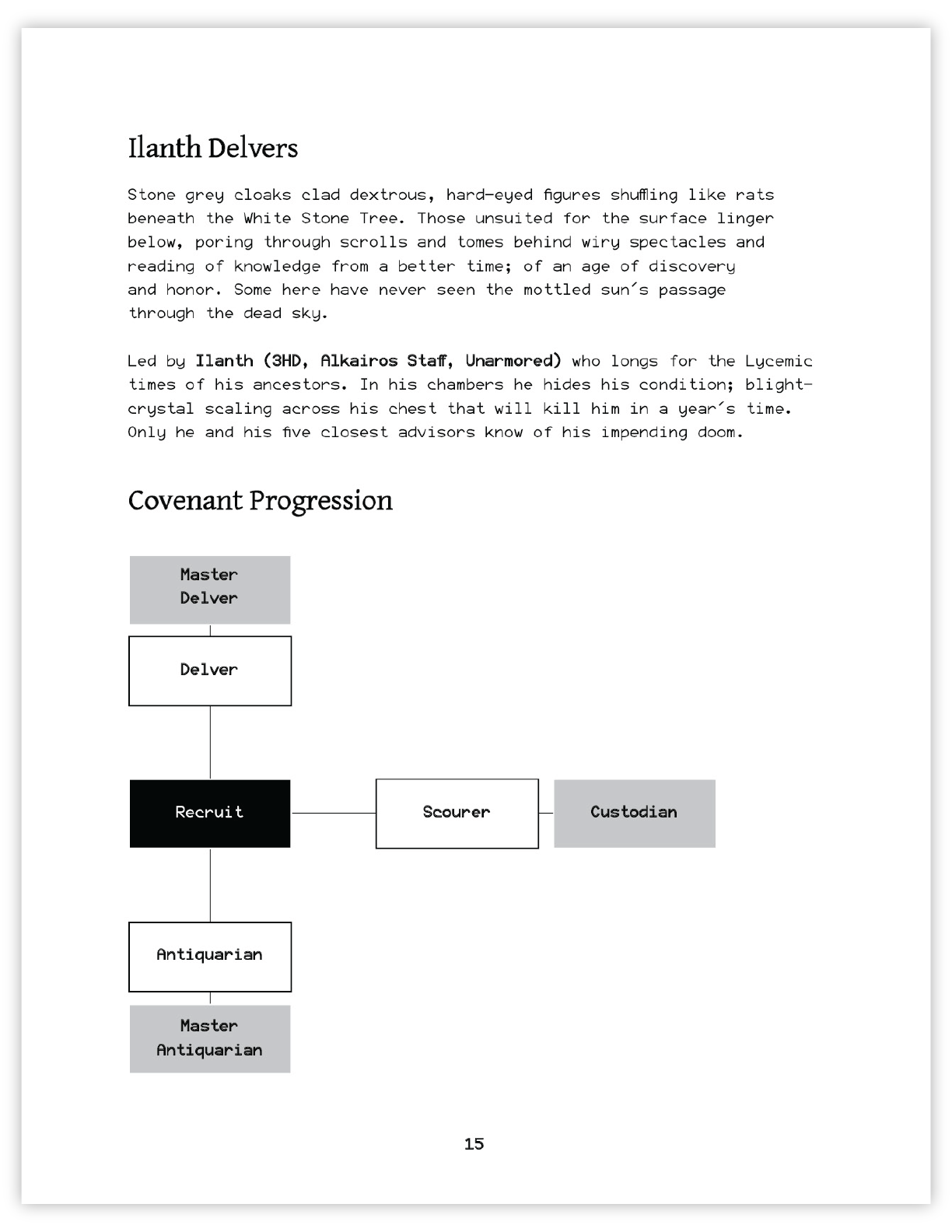
For example, in the Ilanth Delver covenant, one Recruit may follow the Delver path and earn reputation by discovering Minor/Major Relics.
Therefore, they might be granted proficiency in tools required to dig up Relics without inadvertently ruining them.
Another Recruit may follow the Antiquarian path and earn reputation by identifying relics and researching the locations where they were found.
They then may earn a proficiency that allows them to read a classical language like Ancient Solothish.
In both cases, the mechanic is straightforward: a Covenant representative gives you an objective to follow in line with your path, you accomplish said objective, and you earn rewards for your performance.
Exploration and Discovery
The past is distant and murky, made dangerous over eons, and often ignored due to previous eras when discovery often led to cataclysmic disaster. Exploring the world of Ädamίr is the only way to find certain people and places.
Nowadays, most stick to their hovels, refuse to trade with those who don’t speak their tongue, and are outright hostile to those who might invite further doom through “other-ness.”
There are, of course, still people who are fascinated by the past and may offer tantalizing tips about distant ruins and ancient secrets waiting to be discovered:
A Cindervale Knight may be interested in the Court of the Green Flame deep in the Mistlands, where covens of Sisters of the Moon prowl and protect. They only want proof of its existence; what you do there when you find it is up to you.
Another player might uncover a stone map fragment that leads all across the Mistlands, eventually combining with other fragments to form a key to unlock some extant Lycemic Ruin. No one specifically tells you to look around inside—you’re the only one who knows it exists.
In both cases, the players find something or someone that promises to be more than they seem, but perhaps neither the player nor the GM knows exactly what.
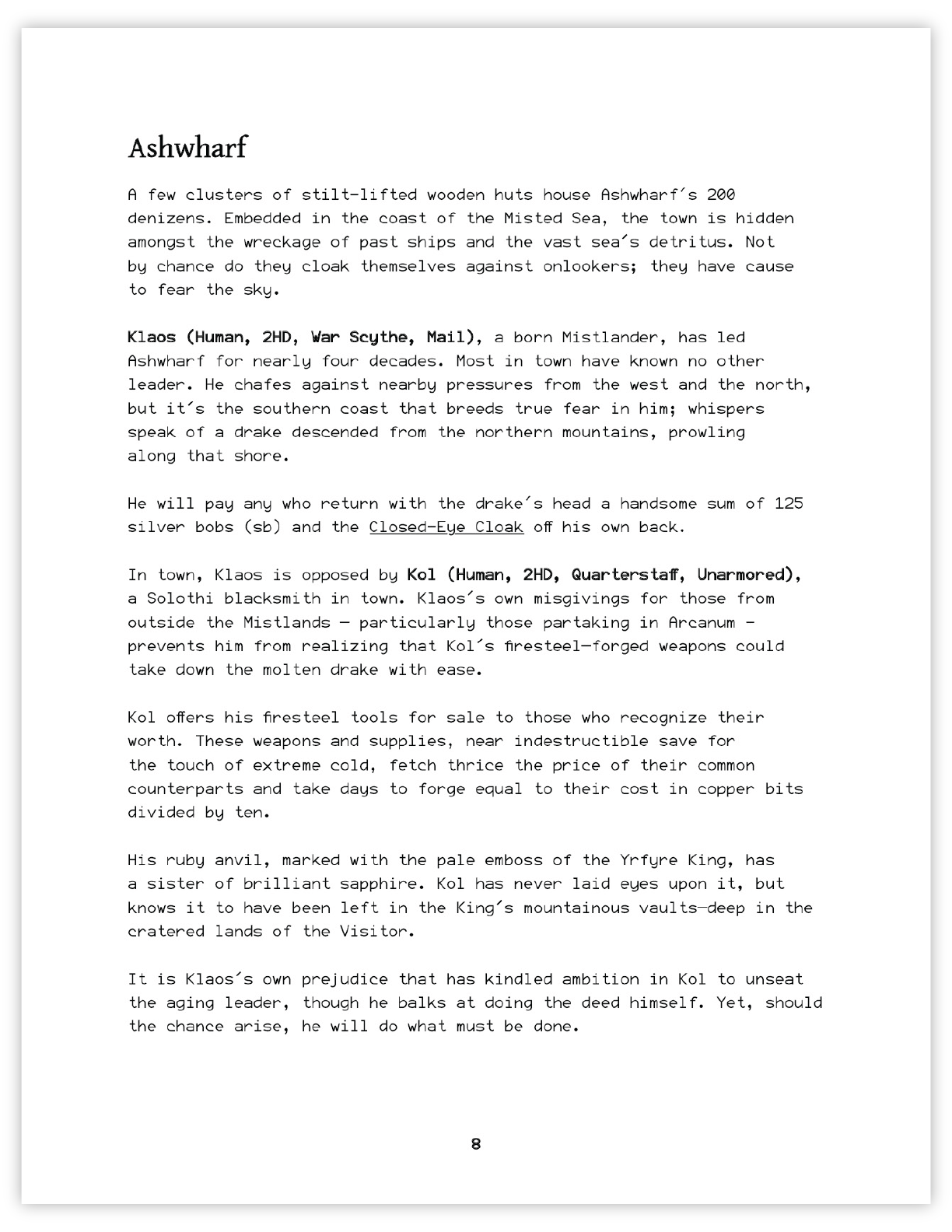
This is a good time to mention that not everything in Ädamίr is specifically outlined in the book. The stone map fragment mentioned earlier may reference a location that does not yet exist, nor is it recorded in the rules or setting guide. In the above image of Ashwharf
Things like that may require the GM (or player) to invent something new that only their table knows.
Final Thoughts
In Ädamίr, one of the more challenging aspects of the design is to choose where to place ‘mechanized’ vs. ‘generative’ content.
Progression through a covenant takes a mechanized approach while also requiring conversation and collaboration with other characters. Advancement through discovery constitutes generative gameplay while also requiring locations to be somewhat hard-coded into the setting so that NPCs and PCs have a geographic frame of reference.
The separation of ‘mechanized’ and ‘generative’ is not linear, nor are the terms mutually exclusive from one another. One isn’t bad while the other is good. One isn’t the right choice while the other is wrong.
Elements of both find their way into every RPG we play, Ädamίr as no exception. In this post’s [ADDENDUM], I discuss a bit more how ‘mechanized’ and ‘generative’ gameplay should be approached in a harmonious way to provide depth to the experience at the table.
While Ädamίr is based on dark fantasy when it comes to setting and the OSR when it comes to rules, it also provides more modern sensibilities regarding reflecting back on the player and the mark they’re making on the world.
Next time, we’ll discuss the difference between Core and Appendix rules (i.e., what you should present to the reader as ‘core’ to the experience and what should be tucked in the back for reference).
Liked what you read?
Don’t miss a new free article posted every Tuesday morning.
Want more? Consider becoming a paid subscriber and gain the following benefits:
Access to [ADDENDUM] articles available only to paid subscribers
Weekly random tables for Ädamίr, my dark fantasy roleplaying game
+10% discount on my crowdfunding projects per year subscribed
Your name listed in thanks, like the fine folks listed at the top of the article
Become a subscriber today!
That’s a very elegant way to tie mechanical advancement and factions into in-game activity.