

Published is Better Than Perfect
My dark fantasy sword and sorcery game, INHERITOR, released its first playtest packet. Here's what I've learned in just under a week and how you can get in on the action.

Last week, I published my first playtest for my dark fantasy rpg, Inheritor. Those of you who downloaded it (thanks by the way!) probably noticed something peculiar: it’s missing bits and pieces here and there.
Now, I could have removed those entirely. After all, why show something that isn’t baked or fully there? Why not just remove the stuff that’s half-built?
There are two reasons:
Because I started on the document to see how far I could get. And yes, I could have used Google Docs or something but… where’s the fun in that? I wanted to see what it would / could look like in its final state.
Because being published and available for download is better than being perfect
I know a lot of you have been working on your own games, your own adventures. Whatever the case may be, you’ve also probably sat and tinkered with it for months—maybe even years.
I know I did, with the earliest rumblings of Inheritor forming around early 2019.
But, what’s the point of trying to make perfection if it never ends up getting seen by anybody? That’s the logic that propelled me to publish Inheritor as it is, warts and all.

There are placeholders throughout it. Places where more stuff plugs in. Spots to imagine, theorize, and ideate on what could go there. It’s rough around the edges.
But, truthfully, there’s also a lot of great stuff too. Stuff I want you to play with and let me know how it feels. Let’s talk about how you can do that.
Iron and Blood - What’s Inside
IRON AND BLOOD is the name of the first playtest packet for Inheritor. It’s a completely placeholder, temporary project name that won’t make it to final production (for example, next month’s update is tentatively called MOON AND MAGICK).
The packet sets the standard for Inheritor: two books, one of rules and the other of setting.
1. Rules

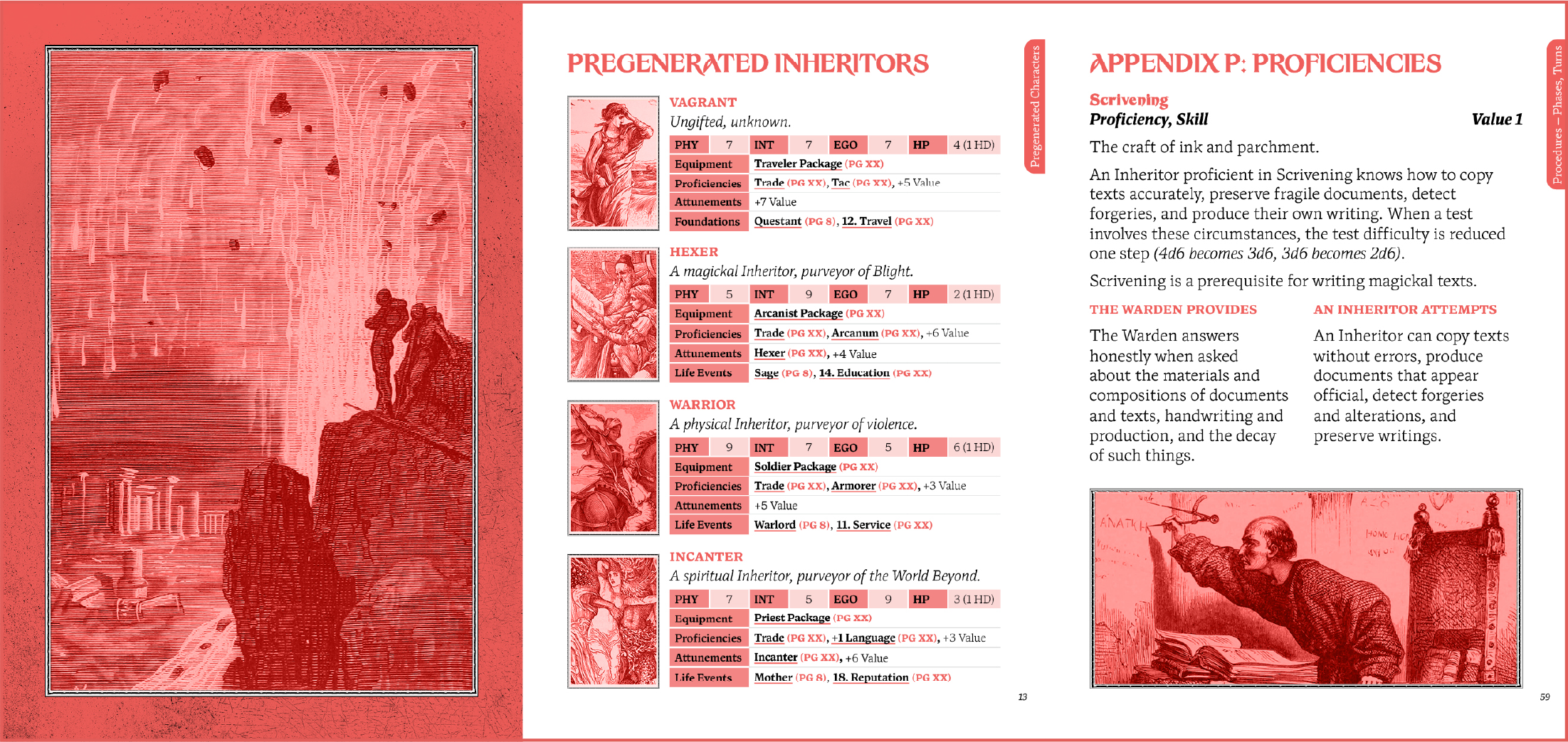
The rule book for Inheritor contains everything needed to make a character and customize them to your liking.
This is done in multiple ways:
A lifepath system for determining past events, prior vocations, and more.
Pregenerated characters that capture the classic archetypes for sword and sorcery.
Rules and procedures used by both players and the Warden to adjudicate play, including weather, the game phases, morale, making claims, becoming tested, and more.
Appendices galore, with equipment lists, proficiencies that aren’t just throwaway lines of text, a smattering of hexes and incantations, and others.
Mistlands

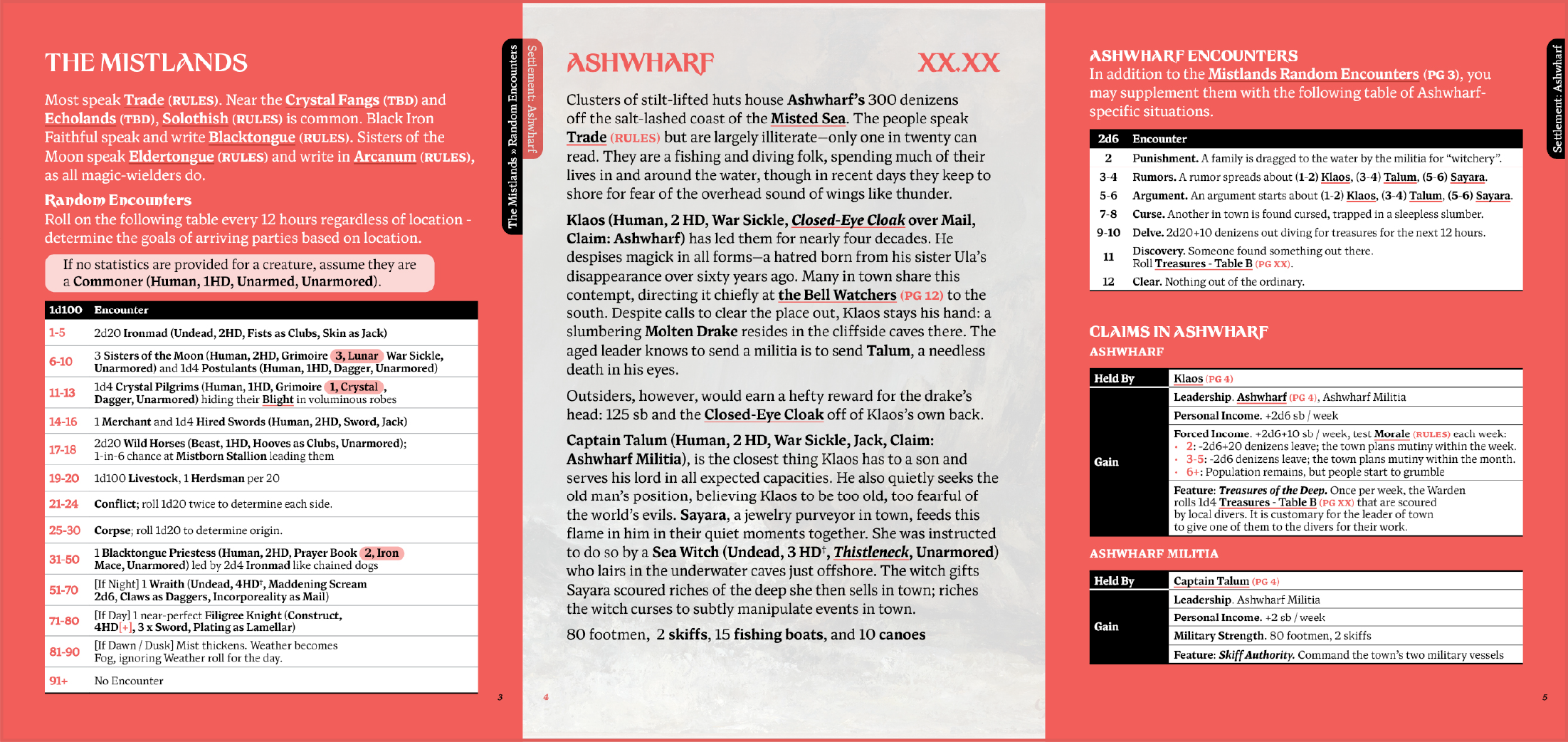
The setting is but one piece of the world, a dense region called the Mistlands. A sort of “demo” offers at least one of each of the major location types: settlement, wilderness, landmark, and dungeon.
Ashwharf, a small settlement on the eastern coast under the claim of a fearful, aging ruler
Greenbury, a wilderness area in the sprawling swamp, besieged by violence and undeath.
Water Wheel, a landmark in the heart of the Mistlands and home to an eccentric silverfisher.
Lunar Chapel, a landmark in the dark woods and home to a blasphemous offshoot of the Sisters of the Moon.
The Bell Watchers, a landmark and small dungeon off the coast of the Misted Sea.
Future playtests will introduce more locations added to the Mistlands, culminating in roughly 30 keyed hexes.
NOTE: The Mistlands book will be released later today!
Future Updates Post Launch

But that’s not all: Once playtesting is over and the final files are sent out, the surrounding regions will be added piece by piece. That means:
The Echolands to the west, home of great deserts, mystical arts, and ancient empires.
The Crystal Fangs to the immediate north, a jagged range of mountains hiding both the past and future of the world.
The Eldlands to the far north, a realm of reflection and ruin—barely touched since the ancient days of the Aelfin.
The Dreaminglands in the place between places, a strange world of impossibilities and violence.
Playtest - How to Participate

With all the files being live on itch.io (go give them a download, what are you waiting for??), that leaves the big question of how this playtest will run. The broad strokes:
The playtest community will be on Discord, using a server specifically and only for Inheritor.
Materials for play, including character sheets, LFG (looking for game) channels, and others will be made available.
Channels for discussing what went right, what went wrong, and what’s almost there
Join the Most Honored Guild of Scriveners (aka, spellcheckers and bugfixers)
Give your thoughts via the playtest survey
We’ll figure out more as we go, but this first playtest is slated to go from now until February 17—then the next update will release and we’ll start the whole shebang over again.
Discord Invite
If you’re participating in the playtest, join us over at the Discord by clicking below:

Until next time!🟦

This article is brought to you by the following paid subscribers who make this newsletter possible:
Azzlegog (Founder)
Colin
Greg
Jan (Founder)
Marty (Founder)
Michael
Mori (Founder)
Reed
Steve
Trevor
Smart call on letting placeholders stay visible, actually shows people what they're getting into for feedback. I playtested a PbtA hack years ago that pretended everything was done and the feedback was useless becasue nobody knew what was rough. That blasphemous offshoot hook for Lunar Chapel is the kind of thing that makes worldbuilding click imediately, single phrase tells a whole story. Lifepath systems either become character generators or busywork but the Mistlands density suggests playtesting will surface which fast.